Friday, 24 February 2012

What we ate: Braised Lamb Shanks

We had one of my best friends over for dinner the other night.  It was actually supposed to be brunch but sick cats and little babies threw a wrench into our plans. Going from brunch to dinner was a bit of a scramble.  Baby A usually goes to bed at 6:30, and Keith and Amanda were bringing their baby for the visit. I didn't want to spend the night cooking so I wanted to have something I can do ahead.  This braised lamb shank was the perfect answer.  The slow braise makes the meat tender and moist.  The slow cooking breaks down the cartilage, collagen and fat and turns   Braising is a simple and easy one put meal.  It is typically highly economical since you would typically use tougher (less expensive) cuts of meat for braising.  You can get creative with different kinds of meat (chick, pork, beef, lamb), veggies (root vegetables, mushrooms, cabbage, artichoke), aromatics (cinnamon, star anise, fennel seeds), braising liquids (wine, stock) but the method and elements are always the same.   Braising is a slow building and layering of flavors.  It always starts with browning of the meat and forms the foundational flavor.  Add aromatics and spices and then a little liquid.  Always go low and slow - low heat, long time.  This braised lamb shank recipe is a great example on how to do this.  I serve this with a simple couscous side and green salad.


mise en place
Braised Lamb Shanks
4 lamb fore shanks
1 can diced tomatoes
1/2 cup golden raisins
1 cup red wine
4 cup of beef stock
1 medium onion thinly sliced
6 cloves of garlic finely chopped
Flour for dusting (season with salt and pepper)
Spice Rub (recipe below)

Pre-heat oven to 350 degrees
Rub a generous amount of the spice rub on each of the lamb shanks.
Dust each lamb shank with the seasoned flour.
Heat a heavy bottomed dutch oven (Le Crueset or something similar) to medium-high heat
Sear and brown the lamb shank, working in batches if necessary (don't crowd your pot)
A nice sear helps build flavor in the braise
Set the lamb shanks to the side, turn heat down to medium
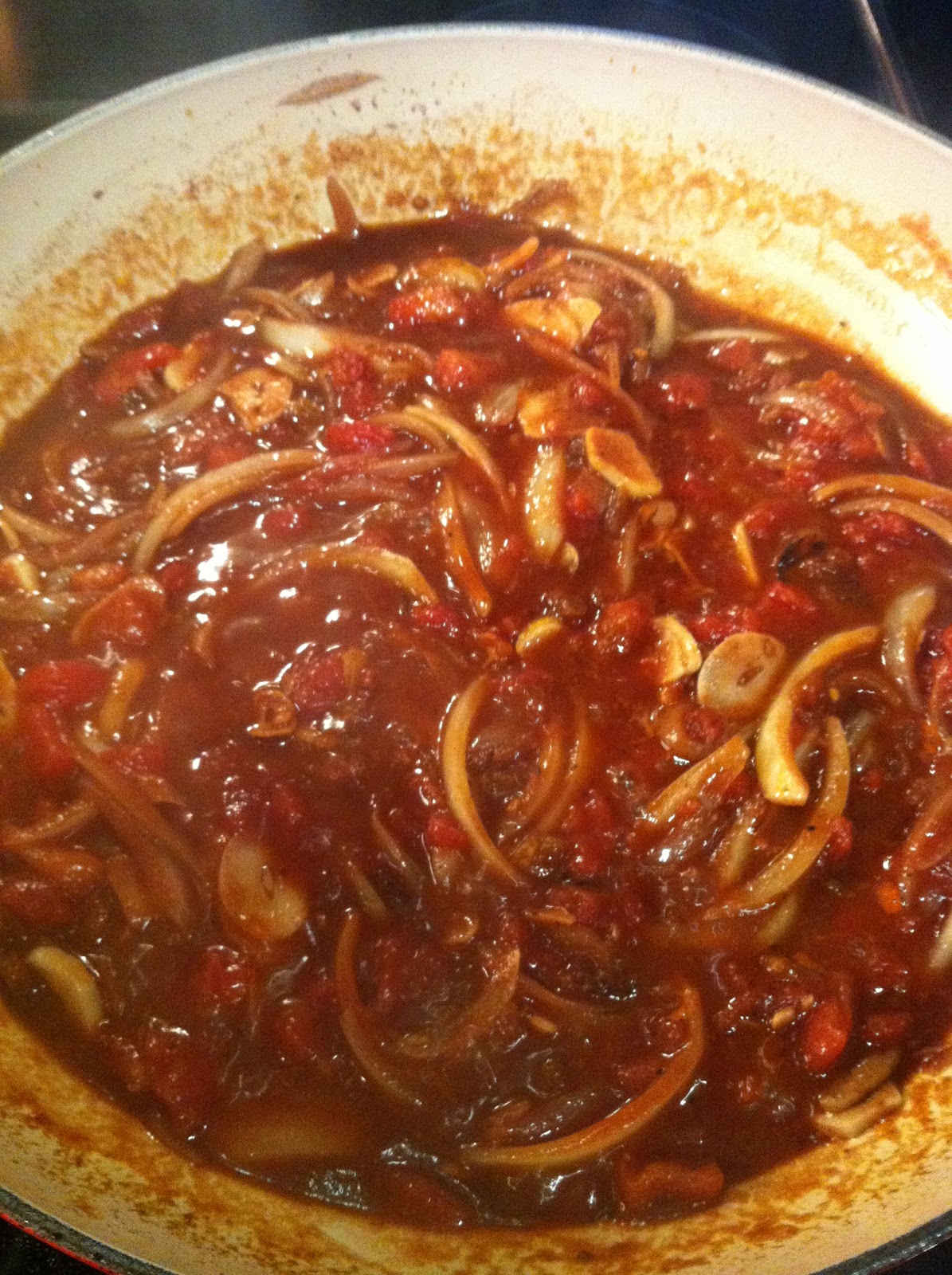
Add onions and garlic into the pot and let this cook down and carmelize but don't let it burn (about 8 minutes)
Add in the raisins, remaining spice rub and diced tomatoes and let it cook for 3 minutes
Add in red wine and let it reduce for another 3-5 minutes
Keep building flavors with aromatics and reducing wine
Add in the beef stock and put the lamb shanks back into the pot
Cover with lid and put the whole pot into the oven and let it braise for 2 hours.
Remove from oven when done and let rest for 10 minutes before serving.
Optional - if you want to make this more refined, you can remove the lamb shanks, skim the braising liquid, put the braising liquid through a food mill and then put it through a fine sieve for a silky smooth sauce.


Spice Rub
1 tsp of coriander seeds
1 tsp of black peppercorns
1 tsp of fennel seeds

1 tsp of caraway seeds
1 tsp of cinnamon
3 tsp of kosher salt

Grind the first 4 ingredients together in a pestle and mortar
Mix in cinnamon and divide the spice mixture in half
Add salt to 1/2 of the spice mix and use that for rubbing the lamb shanks
Reserve the other 1/2 of the spice mix (without salt) and you will use this to put into the braise itself.

 I like to serve this family style with the dutch oven on the table.  We had a green salad and a couscous with raisins and almonds as a side.  Enjoy!


Couscous with toasted almonds and raisins
2 cups of prepared couscous (prepare your couscous either quick server or full grain as per preparation instructions)
1/4 cup of santana raisins
1/4 cup of almond slivers toasted
handful of fresh mint finely chopped
1/4 lemon wedge for juicing
olive oil

Fluff out couscous.
Top with almonds, raisins and chopped mint
Squeeze lemon juice on top and drizzle with olive oil
Mix at the table and serve with lamb.

Monday, 20 February 2012

What we ate: Pan fried ocean perch, sauteed Kale and asapargus risotto

Much like pasta, rice also holds a special place in the heart of the Lo household.  Being Chinese, rice is what fuels me and keeps my blood flowing.  Rice is good anytime, for any meal and cooked in any way.  But admittedly, one of my favorite preparations of rice is not Chinese, but the Italian one.  Creamy smoth risotto perfumed with condiments and sharp parmigiano-reggiano.  I just love it.  There are a few misconceptions about risotto and hopefully this post will do away with some of your fears on making risotto.  First of all, it really doesn't take that much time to make, it should take no more than 18 minutes to al dente from beginning of cooking to the end.  That's all you need.  Second of all, you don't need to stand there and stir it constantly. Sure you need to stir occasionally and you need to keep an eye on it, but as long as you have a good heavy bottomed pan, you are golden.  Third, it should be silk smooth and relatively loose.  It should not be clumpy or thick or pasty.  If you serve it on a plate, the risotto should be loose enough to spread flat on the plate. Finely, use the right rice.  You want the short grain variety and something with a high starch content, which will help make your risotto nice and rich.  I commonly see people use arborio rice for risotto but I tend to stay away from that. I think Carnaroli is the best type of rice for risotto, or vialone nano is a very good rice as well, but it can overcook easily.

Risotto is very flexible and acts as a blank canvas.  You can change up the recipes very easily to make different kinds of risotto. You can use different flavored stocks, different veggies, different meats and even different juices (e.g. Chef Massimo Capri's beet juice risotto is a favorite). 

For this post, I have an asparagus risotto that's scented with lemon zest.  This is great served with fish and was a perfect accompaniment to the fresh ocean perch I bought at the market.  I sauteed some kale to complete the dish.

Asparagus Risotto
Half a bunch of asparagus, bottom inch of the stock removed (set aside and used for flavoring chicken stock) and cut into small pieces on a bias
2 shallots finely diced
1 cup of carnaroli rice
1 cup of dry white wine
3 cups of chicken stock
2 tablespoons of cold butter
1 cup of parmigiano-reggiano
zest of 1 lemon

Take the bottom 1 inch stocks of asparagus and add that to chicken stock and bring it to a boil, turn heat down but keep stock hot (this will help impart some asparagus flavor into the stock)
In heavy bottom pan (I use my Le Crueset dutch oven), heat to medium and add about a tablespoon of olive oil.
Add diced shallots and let it sweat out (cook to translucent but  don't let it burn).
Add carnaroli rice and let the olive oil coat each grain of rice, let it cook for a minute or 2 so the rice 'toasts'. 
Turn the heat up to medium-high, add the cup of white-wine and let the white cook down the rice.  Let it evaporate as this will infuse each grain with some white wine.
As wine evaporates, add a couple of ladles of stock and stir the rice a bit, let the stock cook down and evaporate.
Add more stock and continue the process for about 3 - 4 times (this process should take about 16 minutes from beginning to end)
Add your asparagus to the rice after the 3rd time you add stock.
Taste the rice for doneness.  It should have a bit of a bite in the middle (al dente). Then add one more ladle of stock for the last time to risotto so its nice and loose and turn the heat off (the risotto will cook with only residual heat the rest of the way).
Add the cup of cheese and lemon zest to the risotto and stir this vigorously (to whip air into the risotto and make it light and airy).  Risotto should be a bit loose, add a bit of stock if necessary. 
Add butter and continue to stir butter in vigorously until its all melted. (remember to use cold butter).
Risotto is done.

Pan fried Ocean Perch
4 small Ocean Perch fillets - drizzled with salt and pepper
1 tablespoon of capers
2 shallots thinly sliced
juice 1/2 lemon
tablespoon butter

Rinse perch fillets and pat dry with paper towels (make sure fish is very dry or it will stick)
Drizzle with olive oil and season with salt and pepper.
Heat heavy bottomed fry pan to medium-high
Add tablespoon of butter and tablespoon of olive oil (butter for flavor and oil to prevent butter from burning)
Make sure butter and pan is hot and add fillets skin side down first.
Fry for 3 minutes (don't fuss and move it around, let it fry as is)
Turn the fish over and fry for 3-4 minutes (total cooking time should be around 7-8 minutes)
Remove fish from the pan and set aside.
Add a bit more butter into the pan, add shallots and let the shallots soften and brown a bit.
Add capers and lemon juice, reduce this a bit and scoop shallots and pan juice on top of the fish fillets.

Sauteed Kale
1 bunch of kale - washed and roughly chopped
1/4 white wine
1 clove of garlic finely diced
1 pinch of red pepper flakes
1 anchovy chopped
olive oil

Heat olive oil in pan at medium-high heat
Add garlic, red pepper flakes, and anchovy and sautee for 30 seconds
Add kale and then deglaze pan with white wine
Sautee for 3 - 4 minutes until kale is cooked and softened.

The mise en place
Timing and plating:
The kale can wait a bit but fish and risotto should never have to sit and wait for each other.  These dishes are best served once its ready.  The key to this is having a properly prepped mise en place before you start cooking. Assemble all your ingredients.  Wash, chop and prep all your ingredients and have it all in once place.

I saute the Kale first and set it aside and keep it warm until its ready to be served.
Start with the the risotto and after the second filling of stock (about 10 minutes in) start cooking your fish.  Remember, its important to keep an eye on the risotto and stir occasionally, but it doesn't need constant attention.  The fish takes about 10 minutes from start to finish and should time out nicely with the risotto.  When you put the fish in the pan, don't touch it, let it fry, which gives you a few minutes to tend to the risotto.

This multi-tasking may take some practice but once you've done it a few times it becomes second nature. Once you've made your fair share of risotto, you'll get to know the timing and temperament of the dish and be able to work around it as you prepare other stuff. 

Enjoy!


Thursday, 16 February 2012

Soup Time - Kale and White Bean Soup


I finish this with some grated Parmesan and drizzle of olive oil


Soup is definitely one of my favorite things to eat.  Soup is ubiquitous in the Chinese culture, and I can tell you with confidence that my mom has a soup for every ailment you can think of.  For me, soup is just comfort food.  It's food for the soul. It makes you feel warm and fuzzy inside.  It's fantastic to have a pot of soup in your fridge that you can eat throughout the week.  I was at the St Lawrence Market over the weekend and saw these beautiful ham hocks.  I knew right away they would be perfect for a soup.  I bought one and asked the butcher to cut into 4 smaller pieces. I used one for this soup and put the rest in the freezer for later use.

The mise en place
Ingredients:
Ham hock (1/4 piece, your butcher can cut it for you)
2 carrots - diced
2 stalks of celery - diced
1 medium onion - diced
3 sprigs of thyme
1 bay leaf
2 cups of dried white beans - soaked over night
1/2 bunch of Kale chopped finely
4 litres of water 


1) Heat a heavy bottomed pan to medium-high and add some olive oil. 

Let the veggies sweat but don't burn
2) Sweat carrots, onion and celery - saute until onion becomes translucent, but don't burn the vegetables (about 5-10 minutes)

3) Add ham hock, thyme, bay leaf and beans to the pot.  Cover with water and bring to a boil.

4) Lower heat and let it simmer gently for 45 minutes

5) Remove thyme stems, bay leaf and ham hock from pot.  Let ham hock cool down on the side. Let soup continue to simmer

6) Remove 1/3 of soup with beans and either puree with a hand blender or through a food processor.  Put the pureed soup back into the pot.

7) Remove meat from ham hock and finely chop this and add back into the soup.  Add chopped kale into the soup and let simmer for another 10 minutes.

8) Season with salt and pepper -Optional - grate some Parmesan cheese on top and serve.

Something to keep in mind is that I don't really measure things out nor do I cook off a recipe.  I do this by feel and when you are making this soup, use some discretion.  Watch and taste your soup.  There should be a good balance between broth and veggies/meat.  I generally like my soup to be 1/3 solids and 2/3 broth when the soup is done.  I also like to give my soup lots of time to simmer and let the flavors build.  That means I will ensure I have lots of liquid to start, knowing that I will let it simmer and reduce.  And finally the only time to season your soup is when its done.  If you add salt early in the process, the soup will just cook, reduce and get saltier the longer you cook the soup.  Season once and only at the very end.

Enjoy!


Tuesday, 14 February 2012

Winner winner, chicken dinner - cleaning out my pantry

Fig and Goat Cheese Stuffed Chicken Breast with Balsamic Honey Reduction
Many of my most delicious creations come from cleaning out what I have in the fridge and pantry.  I find that my creativity works best when I have little structure in what I am going to do, but also constrained by what I have available to me.  This dish I did today is not so creative, but it was delicious and let me get rid of dried figs I had sitting in my fridge, half opened package of chevre I used for salad the day before and forced me to butcher the chicken I bought because I wanted to use the bones for stock.  So here it is: Fig and Goat Cheese stuffed Chicken Breast with Balsamic Honey Reduction.

Ingredients:
2 Skin on, boneless chicken breast
6-8 dried black mission figs - halved and stemmed
1 teaspoon of juniper berries
1 teaspoon of whole black peppercorns
2 cloves
1/2 cup balsamic vinegar
1/2 cup water
1 tablespoon of honey
1 tablespoon of butter
1 teaspoon of dijon mustard
1 cup chicken stock
salt and pepper
1/2 package of soft goat cheese (its about 4 tablespoons)

1) Put vinegar, water, cloves, juniper berries, peppercorns, honey into pot and bring to a boil.  Put figs into pot and let it gently simmer for 5 minutes.  Take the pot off the heat, cover and let it stand and cool for 30 minutes.

2) Preheat oven to 375 degrees.

3) Drain the figs and set to the side.  Pour poaching liquid through a sieve to remove any solid bits.  Put the pot of poaching liquid back on to the burner and add in the cup of chicken stock. Bring this to a boil and lower the heat to medium and let it continue to simmer and reduce until you are left with about 1/3 cup of sauce. (You can go to step 4 while you let this simmer, it will take awhile).  Once reduced to 1/3 of a cup, finish the sauce by whisking in 1 tablespoon of butter and dijon mustard. The sauce should thicken slightly and emulsify into a silky smooth reduction.

4) Slice a pocket into the chicken breast by cutting a horizontal cut along the thick side of the chicken breast.  Stick your finger in there and widen it to give yourself a 2 - 3 inch pocket inside the chicken breast.  Stuff each chicken breast with 2 tablespoons of goat cheese and half of the figs.  Season the whole chicken breast with salt and pepper.

5) Heat an oven-safe, heavy bottomed saute pan (i.e. cast iron skillet) to medium-high. Add olive oil and bring it up to heat.  Put chicken breast skin side down first.  Let it sear and brown (about 2 minutes).  Turn the chicken breast over and immediately put into pre-heated oven.  Bake for about 20 minutes or internal temperature reaches 165 degrees.  Take it out of the oven and let it rest for 5 minutes.


6) Serve with balsamic honey reduction.


This turned out really well for a brand new recipe. I'm sure many people have made a similar dish at some point but this was a good way to clean out stuff I already had and I will definitely add this to the repertoire. Hope you enjoy it as much as K and I did.